Pages

Wednesday, 28 March 2012

Insight 2.0: The Future of Social Media Analysis

Just a note to say I'm looking forward to taking part in this event on 27 April looking at the future of social media analysis. 

There are some great speakers including Kevin Anderson, Pippa Norris, Alberto Nardelli, Simon Collister etc etc...it's well worth checking out the programme

I'll be moderating the first panel in my role as "independent social media expert" - a title I wouldn't give to myself but I suppose "done a bit of research about blogging and social media" isn't the way to sell yourself. 

If you're interested in coming along, there are still tickets available and they are very affordable (for those of you who are worried about budgeting for that 20% increase in the price of pasties.)

If you're affiliated to a university there is a special rate of £37 which you can snap up by emailing info@zero1events.com for a discount code.   

Tuesday, 27 March 2012

A note of thanks at the end of the PhD


I'm not sure if a PhD ever really ends.

There seems to be a lot of bits and pieces I'd like to revise and update. Research that I started as part of the project and I'd like to try to finish up for possible future papers.

I'm also hoping to be able to publish the thesis in book form as well which means I might have to revisit some of it for the 654th time.  

But in many other respects the PhD is finished.

I have a piece of paper saying I've passed and the library at King's College, London has a final copy (for a shelf somewhere which will increase the area available in the library for dust-gathering.)

This blog has always been much more of an online research diary and scrapbook than an outlet for my personal story, but I'd like to temporarily hijack it.

I'd be lying if I said the PhD was all a breeze, because with any PhD there are inevitably lows as well as highs. But I'm not somebody who is wondering what the point of it all was.

I've really enjoyed it and I believe it was worthwhile work. I've learnt masses and developed a variety of transferable skills along the way. I believe other people have benefited from the project and others will do so in the future. I've had some great opportunities to do all sorts of exciting things and meet lots of interesting people.

And I'm very grateful for all of that. Rather unfairly, the PhD has my name on the side of the cover, but I am just a small part of the story - the person who brought lots of different things and themes and thinking and hard work together in one place.

And I'd like to say thanks to all the people who made it possible.

In particular, I owe a great debt of gratitude to my family, my friends, my supervisor at the War Studies Department, the Frontline Club, everybody at the BBC who contributed to the project and the Arts and Humanities Research Council for funding me.

I've also benefited immensely from interactions with people online who have taken an interest in the project whether through comments on blog posts either here or at the Frontline Club or on Twitter.

In fact, I can't imagine doing a PhD without access to a 'virtual office' of ideas, information and support. (Although it's not quite as frightening as the prospect of writing one on a typewriter...but anyway).

Finally, I want to say that I dedicated the PhD to my grandparents, Donald and Iris Mead. They gave so much to me in so many ways, but sadly both passed away before I finished the project.

I also want to mention my friend Lineu Vargas - a man who not only took a keen intellectual interest in my work but who was also concerned with my welfare more generally. He was tragically killed in a car accident last year.

It's a comfort to me that the last time I saw him, I was able to celebrate submitting the first version of the PhD with him.

And I'm sure he'll be raising a glass of good red wine somewhere to join in future celebrations...

Wednesday, 21 March 2012

For further thought: The aggregator is king...?

In an era of information overload, the aggregator who points you to the most relevant, most useful, most interesting, most entertaining and most timely content and engages with you in the conversation around that content is king.

Thursday, 8 March 2012

The Russian Internet: "Open and free"

I've just been reading this encouraging report about the state of the Russian Internet.

It suggests that "bottom-up" agenda setting and collective online civic action are all possible in Russian cyberspace. Government control and influence also remains limited.

The report is based on three years of research by the Berkman Center for Internet and Society.

I've picked out a few key points:

Openness and civic action

"Overall, we find that the Russian Internet remains generally open and free despite the various ongoing efforts to shape cyberspace into an environment that is friendlier towards the government."

"The watchdog function of the Russian Internet appears especially strong. There are a large and growing number of examples of Russians identifying problems of common concern and coming together online to push back against abuses of the state or powerful corporate interests."

"The evidence is compelling that Russians are producing and sharing information online that is collectively determined to be of public importance, and in doing so, circumventing the tighter restrictions on traditional media. The ability of Russians to organize and act on that information appears to be equally, if not more important, than the simple access to information and collective filtration of topics and identification of salient agendas."

Pro-government bloggers

"Critically, we do not find evidence that efforts by the government to push its message online through supporters, paid or otherwise, are very successful. The mere presence of pro-Kremlin bloggers does not necessarily translate into influence as the broader online community is not compelled to link to such blogs or to adopt pro-government messages."

"Pro-government blogs are rarely found on our map of prominent blogs as measured by in-links from other bloggers."

Pro-government Twitter users

"However, we do find that pro-government users are more successfully entrenched in Twitter. Specifically, pro-Putin youth groups like the Young Guards and Nashi, and elected officials allied with them, have a distinct Twitter footprint. Still, we find many of the same oppositional groups as we do in the blogosphere on Twitter (with the exception of the nationalists) so more pro-government users have not crowded out oppositional communities."

"We also found evidence that one cluster of Twitter users—those centered on the Medvedev policy of modernization—is popular primarily because it is promoted by bots and instrumental Twitter users."

Methods of control

"There are two methods for controlling online speech that appear to have a greater impact than pro-government information campaigns and are likely to be perpetuated by the government or their sympathizers to limit speech on the Internet."
  • "The first is offline attacks and threats against journalists and others critical of the federal and local officials and powerful business interests..."
  • "The second persistent threat to online speech in Russia is DDoS attacks. The disabling of nearly twenty independent news and election monitoring sites on Election Day is the most extreme and most wide-reaching example of coordinated DDoS attacks in Russia to date."


Wednesday, 8 February 2012

It is necessary to regulate a 'free press' to protect 'freedom of expression'

Yesterday, at the launch event for this new book on the phone hacking scandal something struck me as problematic with the current debate about the future of the press. 

And it was this: the conflation and confusion of 'freedom of expression' with 'freedom of the press'. 

It is particularly misleading in the context of the debate around regulation. Regulating the press will undoubtedly have an impact on the 'freedom of the press'. 

But regulating the press is frequently described as a move that would have a damaging effect on 'freedom of expression': the more regulation of the press you have, the more 'freedom of expression' will suffer. 

What the phone hacking scandal has demonstrated is that quite the opposite can be true: a lack of regulation has meant 'freedom of expression' has suffered. Phone hacking epitomises the way in which 'freedom of expression' can and has been undermined by the 'freedom of the press'. 

I cannot see how 'freedom of expression' has been advanced by the risk that a 'free press' will hack into individuals' private expressions of their views in voicemails and publish them to the world.

And this is merely one aspect which made an impact because it was also illegal.  

Every time the press publishes a headline which has no resemblance to the story beneath or sensationalises a story or rips a quote out of all context or strips people's Facebook profiles for information or decides it would be in the 'public interest' to silence anonymous bloggers or simply makes up a story, the 'free press' assaults 'freedom of expression'. 

Essentially then, the 'free press' damages 'freedom of expression' in two arenas: perhaps most shockingly in the ever-complicating 'private' realm by putting freely expressed private statements into the public domain, but also in the ever-complicating 'public' realm by distorting public announcements.   

The latter is one of the reasons why the PR industry in the UK has grown so substantially. Whether you are a politician or representing a company or increasingly an 'ordinary person', it has become necessary to pay people for expert advice on what you are able to freely express in public. 

And if the boundaries between the 'public' and the 'private' realms continue to blur, how long will it be before each of us needs our own personal PR adviser to help us work out what we are safe to freely express in our increasingly public private lives?         

I believe a 'free press' is vital for democracy. But the time when a 'free press' should have started using that freedom responsibly to stand up for 'freedom for expression' rather than abusing it to turn a profit has already passed. 

We need a more effective system of regulation which protects 'freedom of expression' from a 'free press'. And at the same time, we need to ensure that a newly regulated 'free press' is also able to protect 'freedom of expression'.   

Not least because 'freedom of expression' faces much greater threats, both now and in the future, from companies and governments around the world. 

Monday, 6 February 2012

Phone Hacking: Exploring 'media omerta'


“[Nick] Davies’s work…has gained no traction at all in the rest of Fleet Street, which operates under a system of omerta so strict that it would secure a nod of approbation from the heads of the big New York crime families"
Peter Oborne, The Observer, April 2010


"There seemed to be some omerta principle at work that meant that not a single other national newspaper thought this could possibly be worth an inch of newsprint" 
Alan Rusbridger, Editor of the Guardian, Newsweek, 2011


Tomorrow I'm heading into London to go to Coventry University. (Yep, you heard me right.) I'll be attending the book launch of The Phone Hacking Scandal: Journalism on Trial. And you can still get tickets here if you are interested.

Judith Townend and I have written a chapter for the book exploring Oborne and Rusbridger's assertions that the press significantly under-reported the phone hacking scandal - a news story which would eventually lead to the demise of the News of the World, several high profile resignations and the ongoing Leveson Inquiry.

We thought it would be interesting to find out just what 'media omerta' looked like by tracing how many articles were written on the subject from June 2006 to November 2011 and when they were written.

Using the Nexis database, we counted up the number of articles written on the topic in various newspapers. (At the bottom of this post, I have provided a more detailed explanation of the methodology we used including the limitations of the data.)

The table below shows the total number of articles written and even further below I have produced (at some personal cost to my capacity for patience with Google Documents) a few pretty graphs which show the cumulative total number of articles at 6 month intervals.

If you roll over the blue dots at each point it will tell you the cumulative total at the relevant point in time. (Pretty cool, huh. And really straightforward to produce with Google Docs...see hindsight kicking in already).

Table: Total number of articles June 2006 - 10 November 2011

The Guardian 879
The Independent 489
The Telegraph 436
The Times 332
Daily Mail and Mail on Sunday* 318
Daily Mirror and Sunday Mirror 162
The Sun 112

Graphs: The Broadsheets
Graphs: The Tabloids
Our Chapter

In the book, we use this as a starting point to explore what all of these numbers mean.

We reckon that explanations for the non-reporting of the phone hacking scandal need to delve beyond simplistic, if valid, assertions of industry cover-up.

To understand why the majority of national newspapers didn't regard phone hacking as newsworthy, it is necessary to unpick a tangled web of contributing factors.

In the chapter, we explore competing professional, political and commercial interests; the failure of other organisations – particularly the Metropolitan Police – to investigate the matter thoroughly; and the intimidating power of News International.

Note on Methods

We retrieved articles for the following search terms in news articles between 1 July 2006 and 10 November 2011: (‘phone tapping’) or (‘phone hacking’) or (‘voicemail interception’) and (‘news of the world’). The articles were filtered for ‘moderate similarity’ ensuring that most duplicates were discarded. Some duplicates may not have been filtered out and it is possible that articles relevant to phone hacking which did not satisfy the search terms were not counted. The data should therefore not be regarded as completely accurate in terms of unique numbers but the approach nevertheless provides a valuable assessment of the comparative weight of coverage given to phone hacking by each title. 

*The Nexis database groups Daily and Sunday together.

Thursday, 2 February 2012

Social media from the front line

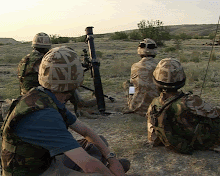
Major Paul Smyth is one of the people responsible for changing the Ministry of Defence’s approach to social media particularly in the context of front line operations.
I’ve spoken to him previously for the Frontline Club about his Frontline bloggers project
In this interview with David Bailey, Maj. Smyth talks in some detail about how he used social media to tell the story of British military deployments from Kosovo to Afghanistan. 
These are a few of the things that caught my eye (after I’d spent a few moments puzzling over the indoor brick wall):
1. In Kosovo, Maj. Smyth began making 2 minute YouTube videos and sending the URLs to journalists in Sarajevo to try to capture their interest. Putting these videos online meant they could also be viewed by military wives, girlfriends and families in the UK.
2. He says that in order to get coverage in national newspapers or on the BBC, he needed an "incredible story". But a blog allowed him to provide "behind the scenes" footage and to publish smaller stories for interested audiences on a regular basis.   
3. He targeted influential defence correspondents and outlets such as CNN’s i-Report spreading his news "footprint over a wider area".  
4. He describes how his blogging team inadvertently trumped the established news procedures of Buckingham Palace and the MoD Press Office.
The team had published a blog post revealing a visit by Princess Anne to Camp Bastion an hour too early. He claims the subsequent coverage of the post on the BBC and in The Times and The Telegraph "surprised a few people".
 
Copyright 2009 Mediating Conflict. Powered by Blogger Blogger Templates create by Deluxe Templates. WP by Masterplan